
I think I’ve managed to find a system of controls for mouse&keyboard, which covers most of the essentials of real-life sword fights. This system hasn’t been tried in any game I know of. Closest match is probably Mount&Blade (M&B). This is about as simple to use for newbies as the M&B system (maybe even simpler!), yet more varied and deep to master for veterans.
This system works with single weapons, sword&shield, 2-handed weapons, spears, practically any melee-weapon you could think of.
Now onto the system itself:
THE GUARDS (or postures with the sword):
The Italian sword-traditions have catalogued theoretically every type of strike the human hand can make. Divided into 8 cuts and 8 thrusts, 1 from each of the 8 major directions, they call these hand postures which prepare each strike, the “guards” (or “guardia” in Italian).
Because the guards reflect real sword-positions, they also work as parries (defences), against those strikes you’d expect (those which strike the blade ie weapon). There is no need for a “parry button”, because all the parries one can make are included within the guards.
I’ll let the following 2 pictures speak for themselves. They include 2/3rds of the full variety of bio-mechanically effective strikes&parries one can make (3rd is lower down, under “BLADE ANGLES”):
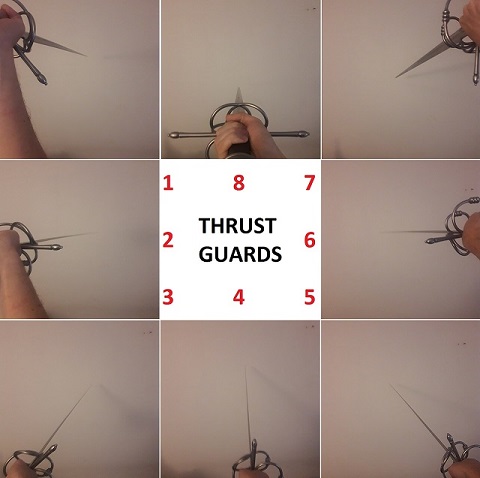
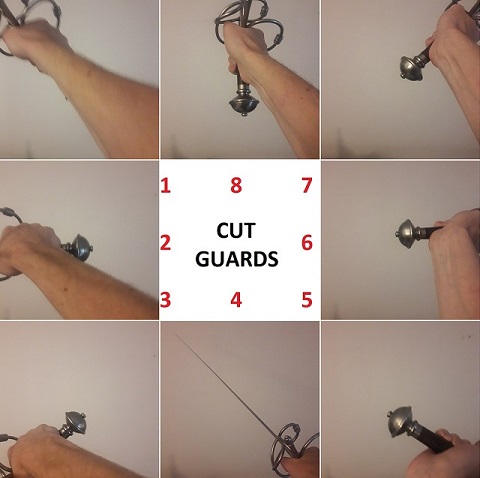
Before you get sceptical about the number of guards, predicting a parrying nightmare, remember that YOU CAN PARRY any of THE 16 POSSIBLE STRIKES WITH ANY 1 GUARD AND 90 DEGREE TURNS at most,
and easier yet: the thrusting guards 3 & 5 can together parry ANY strike with less mouse-movement. If yet you accidentally choose thrust guard 4 (between 3 and 5), a little more mouse_movement achieves the parry.
Choosing any 1 guard, eg from “thrusts”, happens by mouse pressing Mouse1 while mouse moves within any 45 degrees to any of the 8 thrusts. Other strikes (cuts & wides) chosen by pressing eg “c” for “cuts” and eg “x” for “wides”, while mouse movement to chosen sector.
Yet players are able to do smaller mouse_movements than 45 degrees per guard selection, so I believe guard selection would be easy, having tested such movements in M&B multiplayer. 45 degrees is merely this:
up
up right,
right,
down right,
down,
down left,
left,
up left.
Now imagine, that instead of always striking a horizontal cut from right, you’d push mouse up_right, to strike from up right. Better for striking the head than horizontal, for more damage, but also better than a vertical cut, for aiming. But easier to parry than a vertical or horizontal! All these strikes have their goods and bads.
Like you can see, many games already have a similar system in place. The main difference is the variety of directions to strike from, and the separation of strikes into cuts and thrusts. The 3 cuts and 1 thrust of M&B becomes 8 cuts and 8 thrusts, making spears much more dangerous, but swords retaining an edge in versatility because they can also cut effectively. The “parry button” is replaced with 2 “guard buttons”, of which thrust guards are more suitable for parrying, and could be considered the nearest match to M&B 1’s parry button. But for added ease and realism and variety, the cut guards also parry cuts comfortably.
With this full catalog of weapon-positions, we can begin seeing how various sword-interactions, strikes and parries, work in real life, and to make sure our system works the same way. Below I’ve listed some sword-mechanics, giving examples which showcase the possibilities of the system in use. This is all based on real-world sword interactions. I hope to do pictures for these later, so you don’t have to visualize from the above guard pictures, or use your hand as guide in moving from guard to guard.
THE SYSTEM HOLDS TOGETHER ALONG A SWORD-FIGHT:
The Italian tradition realized, that making a cut from 1 direction, naturally ends with you in a thrust guard at the opposite side; cutting is basically a change from 1 guard to another; your hand is always in 1 of these guards, or transitioning between them. Example: cut 1 (up left) into thrust 5 (down right), or cut 2 (mid left) to thrust 6 (mid right), or cut 3 (down left) to thrust 7 (up right), or so on.
THE CONTROLS:
Cutting guards are directed by mouse-movement, when a button is pressed, eg button “C”.
Thrusting guards are also directed by mouse movement when you press eg “V”.
Striking (cutting or thrusting, depending on your guard) happens by Mouse1. Thrusts should optionally stay extended until you “call back” your hand by Mouse1 again, or by a guard change. Striking mid-guard-change should strike with the old guard’s strike before halfway, and after halfway, with the new guard’s strike; striking toward the center of screen always.
Shield guards are chosen by Mouse2+mouse_movement. Without shields, Mouse2 could initiate a grappling action against the body-part closest to the center of the screen. With shields, Mouse2 x2 could bash.
The camera should possibly stay still when a guard is selected by pressing C or V.
Looking around with mouse_movement turns the blade, as in M&B 1, eg look up, blade turns up. And shifts the hand holding the blade, eg look up, hand moves up. Possibly move blade faster than screen.
There are other ways the controls could be done; I currently prefer this.
SWITCHING BETWEEN GUARDS TAKES TIME:
Moving your hand to a nearby guard is faster. Eg moving from 1 (up left) to 7 (up right) is faster than moving it from 1 (up left) to 5 (down right), and so on.
This creates the strategy of changing your guard, and the strike you prepare, to striking where your opponent takes the longest time to parry.
WAYS OF PARRYING STRIKES:
1) Set thrust guard onto way
2) Set cut guard onto way
3) Cut true-edge cut onto enemy strike (true-edge vs false-edge explained under “BLADE ANGLES AND EDGES”)
4) Cut false-edge cut onto enemy strike
5) Guide enemy blade away with a thrust guard, or by a switch to a different thrust guard.
Note how you can parry strikes with strikes. It should add to the ease and variety of parrying.
INITIAL GUARD SELECTION:
Most sword fighters initially hold their sword in thrust 5 (bottom right), which along with thrust guards 3 (bottom left) and 4 (bottom middle) is the safest and most common guard. Why? Thrusting guards 5 and 3 are both already parries against cuts from their respective sides, without additional mouse_movement required. Thrusting guard 4 is a parry with some mouse_movement. And all 3 guards have good thrusts prepared, which discourage the opponent from running into you. But I’ve seen and read about other guards being initial choices.
WAYS OF PASSING ENEMY GUARD:
1) Strike onto an enemy opening
2) Cut onto enemy blade to turn it toward side
3) Change guard to push enemy blade to side
4) Strike onto enemy sword hand
5) Mouse own blade to different side of enemy blade
6) Strike when enemy changes guard
7) Strike when enemy steps forward
CONTINUING YOUR ATTACK AFTER OPPONENT’S PARRY:
Example: You cut from 7 (top right), and your opponent parries with a low-looking thrust guard 3 (your bottom right). Instead of artificially making a “cooldown” before you can act again, like M&B now does, you can tap V+mouse to thrust 6 (middle right), which changes your sword from pointing outside, to pointing right at the opponent and thrusting him if he doesn’t “look up or left” (in thrusting guard 3) or switch to thrusting guards 2 or 1 (which push your blade outside his silhouette).
IMMEDIATE COUNTER-ATTACK:
Example: Example: Your opponent cuts a 7, coming in from your 1 (top left). You want to play it aggressively, so you switch to cut guard 3 (bottom left) or 2 (mid left) and look up, which parries his strike sword-point down. Then you continue your momentum and cleave his head in two with a cut 8 (top middle) or cut 7 (top right). This would create a surprise-effect similar to the now-used “same-sided strike parries” mechanic in M&B.
FEINTS:
Feints would be done by switching your guard before your cut strikes the opponent’s blade or shield, just like M&B does now. Feints are possible with thrusts also.
Example: you make thrust 5 (bottom right) by tapping V while pulling mouse slightly toward 5, then pressing Mouse1. Seeing the opponent parrying it with thrusting guard 3, you tap V and pull mouse toward your own thrust 3 (bottom left). After your sword is withdrawn to the other side of his, you tap Mouse1 to make the thrust. Zig-zag, you’ve just fooled your opponent with a thrusting feint. If you want to execute this perfectly, you actually follow your 2nd thrust 3 into thrust 6 to push opponent’s blade away to prevent any counter-attacks. But this requires 1 more mouse-movement to 6, and so more skill.
SWORD LEVERAGE:
Basic leverage. If your swords are crossed, and his blade is closer to your handle than yours is to his handle, then you’ve got the leverage-advantage, allowing you to control his sword with less effort than him. So switching guards to push his sword away is faster, the better your leverage-advantage.
BLADE ANGLES AND EDGES:
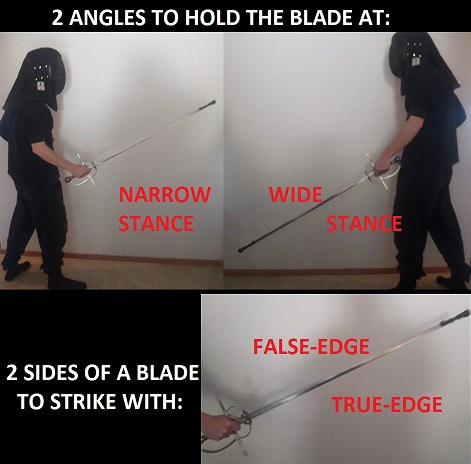
By adding these 2 features into the game, swordplay would gain considerably more variety & depth than already possible with the 8+8 striking system.
1) Switching the angle you hold your sword at, from “narrow” (the typical angle) to “wide”.
This switch could happen by pushing a 3rd button, e.g. “B”.
Using the “wide” angle enables at least 3 new mechanics into swordplay:
1.1) You can parry strikes with your sword-point down, good against strikes to your legs, and facilitating different ripostes than parries with your point up. Now you don’t have to look down for parrying leg strikes.
1.2) You can more clearly invite your opponent to make an attack.
1.3) The “wide” angle is great for preparing false-edge cuts.
1.4) If stamina were ever introduced, then you could rest your hand at the “wide” angle.
–
2) Cutting with the false-edge:
Like the picture shows, many swords have 2 sharpened edges. The “true-edge” is what you usually cut with, but the false-edge has its uses, especially in quick cuts to the opponent’s sword-hand.
In any wide thrust guard, if you press Mouse1, it cuts a false-edge cut ending in the opposite cut guard.
These cuts count as if normal, true-edge cuts, as regards to parrying them. But they prepare different continuations than the same true-edge cuts.
You can also make wonderful parries with the false-edge, such as parrying a “cut 1 coming from 7” by “wide thrust guard 5” and pressing B (back into “narrow thrust guard 5”), striking the incoming cut away with the false-edge as your blade is raised. This enables a nice throat-slashing riposte with a cut 7, but requires competent timing, as compared to merely setting your blade on the way in narrow thrust 5. An easier way to do this same parry+riposte is with wide thrust guard 3 or 4, and pressing Mouse1 into the opposite cut guard.
Note that while I replaced cut 4 (the upward-going true-edge cut) with Guardia di Testa, being in a “wide thrusting guard 4”, pressing the false-edge button (e.g. “B”) or pressing Mouse1, cuts from 4 (into thrust guard 4 or cut guard 8), producing a vertical upwards-going cut, especially dangerous against sword-hands.
—-
I’m not yet sure what should happen if the “narrow to wide” button (“B”) is active in a cut guard; I cannot for now come up with any other useful sword postures.
In cut 4, the “wide” angle could point the blade down, otherwise retaining the same posture.
SMOOTH GUARD SELECTION (optional):
Best guard selection results would come from a smooth transition between guards, ie any difference in the direction of your mouse_movement affects the direction of your guard placement, ie you can choose guards between the above pictures’ “guard prototypes”. This minimizes problems from you accidentally choosing a wrong guard. The only “but” here seems cut guard 4, where the blade’s direction changes fast between cut 4 and cut 5. But the essence of each in-between guard stays similar to cut 4’s properties, eventually with the blade pointing right (the other way around), parrying cuts from the opposite direction to default cut 4, until the in-betweens begin resembling cut 5 more (which still parries cuts from the same direction as the in-between).
CUT STRIKING MOMENTUM (optional):
The system realistically implements an ability to choose how strongly or quickly you cut from your chosen direction:
We are in thrusting guard 5 (bottom right). We want to begin the fight with a cut from 7 (up right). If now simply C+Mouse_up_right then Mouse1, to directly lift toward and cut from 7, using the sword in a hammer-like manner, then the cut isn’t going to be as strong as if we had GATHERED MORE MOMENTUM in a circular arc from eg cut 1 (top left), as in the picture below:
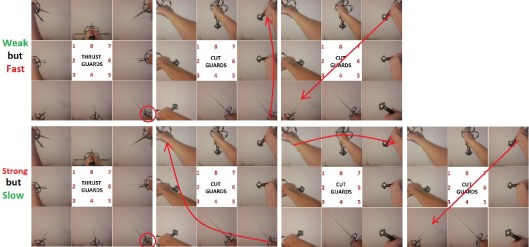
In the hammer strike, our hand will have traveled a slightly lesser distance, but the closer you gather to where you’re cutting, the weaker your cut is going to be; the farther you gather, the slower your gather but stronger your cut. Gathering from a direction adjacent to where you’ll cut, is very weak. The next-closest gather is already significantly more powerful. So if striking from 7, speed of gathering goes 8>1>2>3, but strength goes 3>2>1>8. If you begin from a cutting guard, or stay in it for a while, you’ll have more force than if gathering from an adjacent guard, but less force than if you’d gathered from a farther guard.
So here we see skill in action: the competent swordsman swings his sword around his back via cut 1, and cuts with slower or near-equal gathering-speed but greater force than the hammerer.
CUT PARRYING MOMENTUM (optional):
Using the momentum of an opponent’s cut, to make your own riposte faster.
Example: your opponent tries to cut you with a well-gathered 1, which comes in from your 7. You parry it with thrusting guard 5, which knocks your sword slightly toward 4. Now your sword has left-directed momentum, so you continue the movement via cutting guards 4, 3, 2, or even 1, and riposte with added speed from e.g. 7, which is undefended as long as your opponent doesn’t change his guard (which became thrust 5 the opposite of 1), or look left and up in thrust 5.
MORE ON PARRYING WITH MOUSE MOVEMENT:
Parrying cuts works with any guards from the side of the incoming cut. The angle of mouse_movement from which a cut is parryable without much difficulty is 3 guards, or 3*45 degrees = 135 degrees, 1½ times more than the 90 degrees in M&B 1. The difference is, if you don’t choose from the exact 45 degrees per 1 guard, you need mouse_movement to turn your blade properly:
Very intuitive: simply face the direction of the incoming cut; if you choose too high a guard, you must look down to turn your blade down and onto the way. If too low a guard, look up. Too much left, turn right. Too much right, turn left.
With smooth guard selection, choosing an unsuitable guard by accident becomes rare.
Also you wouldn’t have to keep pressing “parry button” to parry, removing the case where you let go too early and take the hit. Even if you change guard too early, the change is not instantaneous but smooth, so you may accidentally parry anyway.
I’m not sure, but I’m beginning to think that elementary parrying would be easier than in M&B 1.
Whatever the parry success percentages would look like in practice, the easier parrying is, the more damage should be caused by a single strike success. The more difficult parrying, the less damage per strike success.
Parrying thrusts is easiest with thrusting guards, and happens by guiding the thrust outside your silhouette, doable with 22.5 degree turn, or with a switch to another thrust guard.
Parrying thrusts with cut guards require such timing as to be difficult.
The more your guard’s direction differs from the incoming strike’s direction, the more you have to turn to parry. Wrong-sided parries require such mouse_movement, that their success seems difficult in practice, and they also place the parrier into a disadvantageous angle, making ripostes (counter-strikes) more difficult, and allowing continuation attacks which require heroic mouse_movement to keep parrying.
Overall, I think parrying looks very manageable.
—-
SUMMARIZING THESE FEATURES, the following changes should apply compared to M&B1:
Unite strikes and parries into guards; no parry button needed. Add more guards. Add sword collision detection. Remove cooldown after block. Slow down guard changing slightly. Add speed to guard change from successful defences, to the guards in that direction where the attack went. Make defender’s blade turn into that direction where the attack went, degree of change depending on how well-gathered the attack was, and more the nearer to the tip of defender’s blade it struck, and more by how near the attacker’s handle it struck (leverage). Make attacker’s blade change from the attack’s default opposite guard, to stop at where the defender’s blade stopped to. Make blade rotate if swords collide when other player changes his guard to push opponent’s sword away. That’s about it… maybe.
—-
There are many more details which could be mentioned, a lot of play-testing to be done for sure, a challenge to the developers. But if the system would work in a polished version, it could actually revolutionize sword-fighting games. Imagine playing a computer-game and LEARNING REAL-WORLD SWORDSMANSHIP!
Some examples of further details:
1) You can actually parry an overhead cut (cut 8) with the thrusting guard 8, by looking up. The opponent’s cut lands on either of your sword’s quillons, and you can move his sword around with yours, for a good riposte.
2) There is a type of cut called the “stramazzone”, where you move practically only your wrist, gather from your “inside” (belly side), and cut. It’s quick, and good for continuing a series of cuts. The controls could be set so that if you gather from cut 3, and cut (mouse1) immediately from cut 1, 8, 7, 6, then the cut is made as a stramazzone.
3) Optionally there could be a button for transitioning between styles, ie the opposite of cut 7 would be cut 3 instead of thrust 3. This would enable easier cutting continuations, but would expose the player to easier counter-strikes. Good against fleeing enemies or poorly armed enemies? Maybe even enable the player to make their own styles, ie choose any opposite to any strike! But naturally the momentum takes, for some time, toward the default opposites, ie from 7 to 3, or from 1 to 5, or from 2 to 6, or so on.
4) From the system, I’ve replaced cut 4, which would strike with the “true-edge of the blade” from below directly upwards. Why? Because this cut is difficult to make, doesn’t contain much force or speed, and I’ve never seen it used in serious swordplay. Instead, cut 4 now features the “Guardia di Testa”, which is the only guard I couldn’t otherwise include in the system without needlessly adding a special button for it. Guardia di Testa can be used to block overhead cuts (cut 8) by looking up, and to quickly parry thrusts by timely switching to the proper thrusting guard. Also it’s ready to push the blade into the opponent.
5) Also thrust 8 is in the middle of your chest, because thrusting the sword from higher would be clumsy and tiring.
FOOTWORK (optional):
Default movement would be same as now: running, ie “passing steps”, where your back-leg passes to front. As now, you can stop the animation by letting go of movement key(s).
When a “walking button” is pressed, you’d step forward with your front-leg, and follow with your back-leg behind it, to stay in good posture. This is the “accrescimento” step (literally “increasing step”). You’ve seen this in movies and games, and it’s natural in a careful sword-fight.
When moving backward, the front-leg should withdraw first, for evading strikes better.
When the “walk button” is pressed, and you press forward-button twice, your back-leg gathers first behind the front-leg, and then your front-leg takes an accrescimento forward. This is the “gathering step”. Less easy to react to, allows a longer accrescimento, but while your back-leg is moving, your front-leg cannot withdraw for evading, because your weight is resting on it.
This control system includes the full variety of footwork: passing steps, increasing steps, gathering steps.
Also, your front-leg should stay the same unless you change it by running: ie begin with right-foot forward, run forward to put your left-leg forward, stay in that posture unless you run more. Now you can take increasing steps with the left-leg in front, until you run again (take an odd number of passing steps). This enables you to choose twice the number of postures than were previously possible. Leg frontness decides which strikes to use or not use against legs: enemy right foot forward has the leg on your left side, so your left-side strikes are faster to strike home. Left foot forward, right sided strikes.
HOW THE SYSTEM INCLUDES DIFFERENT STYLES:
Style is about which guards (strikes, parries), and continuations to favor over others. This system should include every style, because no biomechanically effective sword posture is possible which would not be included here. Or do you see any not mentioned here?
Example: Compare a reconstruction of ancient Roman legionary style with this system:
Roman legionary gladius training
While at first sight the fighting-style may seem completely different to the “Italian” one I advocate, if we “import” the moves, see where and how the sword resides at each technique, we find that there are 4 thrusting guards advocated, which can all be found in the “Italian” style, but in this “Roman” style with minor equipment-driven differences:
1) “High-line horizontal” is “thrust 8” but palm down, which is a logical difference in animation when holding such large shields, because the hand is held farther-back to cover it behind that shield, and then palm up would strain your wrist, and force you to keep your hand higher to prevent your knuckles from striking your shield.
2) “High-line thrust” is “thrust 7” held closer, adjacent to the shield, so as not to expose the hand. This is again a logical variety in animation.
3) “Mid-line thrust” is “thrust 6”, again adjacent to the shield.
4) “Low-line thrust” is “thrust 5” adjacent and held horizontal.
And for the cuts:
5) “Right cut to neck” is “cut 7”.
6) “Left cut to neck” is “cut 1”.
7) “Right cut to leg” is “cut 6” or “cut 5”.
8 ) “Left cut to leg” is “cut 2” or “cut 3”.
The remainder of the variety can be directed with mouse-movement. Probably the best results would come if during strikes mouse-movement would not tilt the shield, only direct the sword. Or direct the shield only slowly.
So the Roman style of combat, as advocated in the video, is a subset of the more-extensive “Italian” catalogue, with slight variations in animation to reflect the equipment-driven stylistic differences.
Even here, I see no reason to restrict the player from trying the other types of guards and strikes in the full catalogue, and learning first-hand why the Romans probably never used such guards as “thrust 2”: there’s no room behind the shield, and why expose your hand in front? So thrust 2 would need to turn the shield to the side, exposing the fighter to easier attacks.
Also, retaining the full catalogue of guards should be useful if the blades somehow get locked together, for maneuvering your sword-hand.
This system is also possible to be streamlined completely, so that any strike (cut or thrust) could be parried without mouse_movement from their same sided thrust guard and its 2 adjacent thrust guards, so 3 thrust guards around the incoming strike’s direction. This would be very similar to M&B 1’s system, with the added variety, immersion, and skill fine-tuning from the added strikes, also fixing spears, and improving indoors striking (where walls often block horizontal cuts).
End of my post. These are the main-features of the system I’ve imagined. It probably takes some skills and patience to program, but I like its possibilities. Would certainly like to try this one out.

